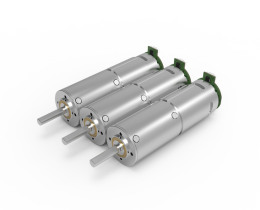


Looking for a suitable motor?

小编
Published2025-10-15
Understanding the Basics of a Servo Motor
Imagine a marvel of engineering that can rotate a shaft with incredible precision, respond swiftly to commands, and maintain exact positioning—welcome to the world of servo motors. These tiny yet mighty devices are the powerhouse behind countless applications ranging from robotic arms to camera autofocus systems. But how exactly does a servo motor work its magic? Let’s break it down step by step.
At their core, servo motors are a subset of rotary actuators—that is, devices that produce rotational movement. Unlike simple motors, which just spin freely when powered, servo motors are designed for precise control of angular position, velocity, and acceleration. They do this through a combination of a motor, a feedback mechanism, and a control circuit, all working together seamlessly.
Key Components of a Servo System
The Motor: Usually, a small DC motor or sometimes an AC motor, depending on the application. This motor provides the rotational force needed to move the shaft.
Feedback Device: Typically a potentiometer, encoder, or resolver that constantly measures the position of the motor shaft. The feedback allows the system to know exactly where the shaft is at any given moment.
Control Circuit: An electronic controller, often a dedicated servo amplifier or a microcontroller, compares the feedback signal to a desired target position. If there’s a discrepancy—called an error—the controller adjusts the motor’s power to correct it.
Gear Train: Sometimes included to reduce speed and increase torque, especially when high precision is needed.
What sets a servo motor apart is that it operates within a closed-loop control system. Unlike open-loop systems, which run without feedback, a servo continuously monitors its position and makes real-time adjustments. This feedback loop ensures the motor accurately reaches and maintains the intended position—crucial for tasks demanding high accuracy.
Suppose you want to rotate a robotic arm’s joint to a specific angle. The control circuit sends a command signal to the motor, instructing it to turn. The feedback device measures the current position, and the controller compares it to the target angle. If the motor isn’t in the right place, the controller adjusts the voltage or current supplied to the motor, prompting it to move precisely. This cycle repeats rapidly, often many times per second, resulting in smooth, accurate motion.
How the Control Signal Works
The control signal typically comes in as a Pulse Width Modulation (PWM) signal or a digital command that indicates the desired position as an angle or a percentage of maximum rotation. The servo motor’s driver circuitry interprets this command, providing the appropriate current levels to the motor.
Because of rapid feedback and adjustment, servo motors excel at holding a position against external forces—even if someone pushes against the shaft. They can also accelerate quickly to a new position and maintain that position under load.
While the underlying principles are common, servo motors come in different types suited for various applications:
AC Servo Motors: They operate on alternating current and often feature built-in control electronics. They are used in industrial automation where high power and durability are required.
DC Servo Motors: Powered by direct current, these are more prevalent for small-scale or hobbyist projects. They are easy to control and maintain.
Brushless Servo Motors: These motors eliminate brushes, reducing wear and providing higher efficiency. They are increasingly popular in high-performance robotics and aerospace.
Applications That Rely on Servo Motors
Servo motors are integral to many cutting-edge technologies:
Robotics: For joints, grippers, and precise movement control. CNC Machines: Ensuring precise cutting paths with accurate positioning. Camera Focus Systems: Fine-tuning lens positions for clear images. Automotive Engineering: Power steering, throttle control, and electric seats. Aerospace: Flight control surfaces requiring exact movements.
In essence, the ingenuity of a servo motor lies in its ability to combine motor technology with feedback systems, creating a smart, responsive device capable of high-precision tasks that underpin the automation revolution.
Delving Deeper into the Mechanics of Servo Motors
Having grasped the fundamental components and their roles, it’s fascinating to explore how these elements integrate to deliver such impressive performance. Let’s uncover the inner workings step by step with a focus on the control loop, speed regulation, and the importance of tuning a servo for optimal performance.
The Control Loop in Action
At the heart of a servo system is the control loop, governed by a control algorithm, often a Proportional-Integral-Derivative (PID) controller. This algorithm determines how the motor responds to errors—differences between the desired and actual positions.
Proportional Control (P): The correction is proportional to the error. Larger errors result in bigger corrections.
Integral Control (I): Addressing accumulated errors over time, it's used to eliminate steady-state discrepancies.
Derivative Control (D): Anticipates future errors based on the current rate of change, smoothing out the movement and preventing overshoot.
By fine-tuning these parameters, engineers ensure the servo responds accurately and efficiently without oscillations or sluggishness. The controller calculates the corrective command and applies it via PWM signals or variable voltage/current to the motor.
Motor and Feedback Synchronization
Suppose the system receives a command to turn the shaft to 90°. The feedback device, say an encoder, continuously measures the shaft position. Initially, the error is significant, so the control algorithm supplies full power to the motor. As the motor approaches 90°, the error diminishes, and the controller reduces the power, preventing overshoot.
This dynamic adjustment allows the servo to settle precisely at the target angle, demonstrating a process called “closed-loop control.” The system maintains the position, even if external forces threaten to move the shaft, thanks to the motor’s strong torque and real-time feedback adjustments.
Speed Control and Responsiveness
Servo motors can also vary their speed, not just position. This involves controlling the voltage, current, or PWM duty cycle so the motor accelerates smoothly or responds rapidly to commands. For example, in a robotic arm, fast movements benefit from high responsiveness, while delicate tasks require gentle, precise motions.
Speed control is often achieved by modifying the control signal based on the difference between current speed and the target velocity, adding another layer of complexity in the control algorithms.
Servo motors are designed to deliver high torque, especially at low speeds or when holding a position against external forces. The gear train can magnify torque, but the motor itself must be capable of sustaining such loads without stalling or overheating.
The ability to hold a position under load is a major advantage. When the motor reaches the desired angle, the control system maintains the current to keep the shaft steady. For example, in a robotic gripper, the servo must cling onto objects firmly without drifting.
Tuning a Servo for Peak Performance
One of the trickier aspects of deploying servo systems is tuning—the process of adjusting the control parameters to achieve optimal response without instability. An improperly tuned servo can oscillate, overshoot, or respond sluggishly.
Tuning involves methodical adjustments to the PID coefficients:
Increasing proportional gain improves responsiveness but may cause oscillations. Adjusting integral gain helps eliminate steady-state errors but can introduce lag or instability. Derivative gain dampens oscillations, smoothing the response.
Practitioners often use trial-and-error or software tools to computerized tuning, aligning the servo’s behavior with specific application needs.
Advancements and Future of Servo Technology
The evolution of servo motors continues apace, driven by miniaturization, increased computational power, and new materials. Brushless design and digital control electronics now allow for more precise, quieter, and energy-efficient servos.
Emerging technologies like "smart servos" enable self-diagnosis, predictive maintenance, and integration with IoT ecosystems, transforming automation into more adaptive, intelligent systems.
Why Servo Motors Dominate the Automation Landscape
With their unparalleled accuracy, fast response times, and reliable control, servo motors have become the backbone of sophisticated automation. Whether it’s a robotic surgeon’s hand, a 3D printer’s nozzle, or an autonomous drone's flight control surfaces, they are the unseen heroes powering progress.
Understanding how a servo motor works is not just about appreciating its mechanical and electrical marvels but recognizing its role as a bridge between digital commands and physical motion. As automation advances, these tiny yet intricate devices will continue to evolve, delivering even higher speeds, precision, and intelligence, shaping a future where machines match human finesse in movement.
I hope this gives a comprehensive view of servo motors—how they work, their mechanics, and their pivotal role across industries. If you'd like me to delve into specific applications or technical details, just say the word!
Established in 2005, Kpower has been dedicated to a professional compact motion unit manufacturer, headquartered in Dongguan, Guangdong Province, China.
Update:2025-10-15
Contact Kpower's product specialist to recommend suitable motor or gearbox for your product.