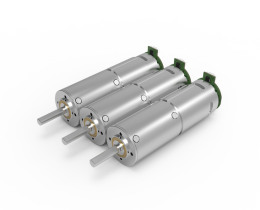


Looking for a suitable motor?

小编
Published2025-10-15
In the mesmerizing dance of modern machinery, where precision and speed intertwine seamlessly, servo motors stand out as essential performers. These tiny yet powerful devices are the unsung heroes in everything from robotic arms manufacturing our smartphones to the camera autofocus systems capturing life’s fleeting moments. But have you ever wondered how these marvels of engineering actually work? Let’s take an intriguing journey into the world of servo motors, unraveling their secrets and understanding what makes them so uniquely capable of granting machines both agility and accuracy.
.webp)
To start, think of a servo motor as a highly intelligent muscle. Unlike a simple motor which just spins at a set speed when power is applied, a servo motor is equipped with a built-in control system that constantly checks its position and adjusts accordingly. This ability to "know where it is" and "move precisely" is what makes it indispensable in applications demanding exactitude.
So, what defines a servo motor? Broadly, it can be seen as a rotary actuator with a dedicated feedback mechanism, usually a sensor, that continuously reports the position, speed, and sometimes even the torque of the motor shaft. This feedback loop is the magic ingredient, transforming a basic motor into a precise control device.
Imagine controlling a robotic arm that sorts tiny electronic components. Every movement must be calculated and exact—one misaligned part can mean delay, waste, or failure. That’s where the servo motor’s ability to reach and maintain specific angles or positions becomes crucial.
At most, servo motors are a type of AC or DC motor paired with a control circuit and feedback device. The control circuit acts like the brain, processing commands and adjusting the motor's behavior based on real-time feedback. When a system sends a command—for example, to position a robotic gripper—the internal circuitry evaluates the current position of the motor shaft, compares it to the target, and coordinates the power supplied to the motor windings or brushes to correct any discrepancy.
But how exactly does this process unfold? And what components come together to make a servo motor tick? Let’s break it down.
The core components of a typical servo motor setup include the motor itself—either brushed or brushless—an encoder or potentiometer for feedback, a driver or controller, and the power supply. Each piece plays a vital role in ensuring smooth, accurate operation.
Brushless servo motors, common in high-performance applications, are particularly interesting because they use electronic commutation instead of brushes. This reduces wear and tear and refines control quality. Whether brushed or brushless, the fundamental operation hinges on a control loop called a PID controller—short for Proportional-Integral-Derivative. Think of it as a sophisticated navigation system, constantly calculating the difference between the current angle and the desired angle (that's the “error”) and making minute adjustments to minimize that error.
Now, let’s consider the sensory feedback. The encoder, often an optical or magnetic device, continuously reads the shaft’s position and transmits this data back to the controller. It’s akin to a GPS system constantly updating your location on a map. Using this data, the PID controller determines how much to adjust muscle—meaning how much voltage or current to send to the motor—to reach and hold the target position.
This closed-loop system allows for remarkably precise control, sometimes down to fractions of a degree. It also contributes to the efficiency of the system, as the motor isn’t just spinning aimlessly but moving deliberately towards a goal, correcting itself along the way.
From an operational perspective, servo motors operate in a cycle: they receive a command signal that specifies a position, the motor moves toward that position, the feedback device monitors its progress, and the controller adjusts power until the exact position is achieved and maintained.
To better visualize this process, imagine turning a steering wheel. If you turn it slightly, the feedback is immediate—you feel the resistance and see the wheels turn. If you specify a turn of 90 degrees, you push with a certain force until the wheel reaches that position, then hold it steady. In a servo system, this “push” is automated by the control circuitry, making tiny, rapid corrections—often hundreds or thousands of times each second—to maintain perfect positioning.
But what about the different kinds of servo motors? Turns out, there are mainly two categories: AC servo motors and DC servo motors. Each has its characteristics, advantages, and typical uses. AC servo motors, often brushless, excel in applications requiring high power and efficiency, such as industrial robotics and CNC machinery. DC servo motors, including brushed varieties, are more straightforward and are used in lighter or less demanding tasks.
In addition, the strength of a servo motor isn’t just in its power but in its adaptability. Whether it’s spinning a gear in a tiny robotic finger or moving a heavy robotic limb, servo motors deliver high torque at precise positions, making them versatile players in the realm of automated precision.
Now, stepping back from the technical details, it’s quite astonishing to realize that these compact devices integrate mechanical movement, electronic control, and sensory perception into a single package. They exemplify how modern engineering blends physics, electronics, and computer science—creating systems that are both incredibly precise and adaptable.
And that’s just the beginning of their story. The next part will explore real-world applications, innovations shaping the future of servo motors, and the challenges engineers face in refining these marvels of motion control. Whether it's in robotics, aerospace, or entertainment—servo motors are quietly transforming the way machines think, move, and interact.
Kpower has delivered professional drive system solutions to over 500 enterprise clients globally with products covering various fields such as Smart Home Systems, Automatic Electronics, Robotics, Precision Agriculture, Drones, and Industrial Automation.
Update:2025-10-15
Contact Kpower's product specialist to recommend suitable motor or gearbox for your product.