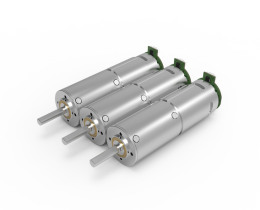


Looking for a suitable motor?

小编
Published2025-10-15
Imagine a world where everything moves with perfect precision—from robotic arms assembling delicate electronics to drones navigating complex airspaces. At the heart of these marvels of technology lies a humble yet sophisticated device: the servo motor. Though small in size, servo motors pack a punch, wielding the power to execute exact movements with remarkable accuracy.

But what exactly makes a servo motor tick? To unravel this, let’s start with the basics.
What is a Servo Motor? A servo motor is a rotary or linear actuator that allows for precise control of angular or linear position, velocity, and acceleration. Unlike simple motors that run at full speed or stop altogether, servo motors are intelligent devices that can rotate to a specific position, hold that position, and make smooth adjustments as needed. Their precision makes them indispensable in robotics, CNC machinery, remote-controlled vehicles, and automation systems.
Core Components and How They Interact At its core, a typical servo motor comprises several key parts:
Motor (Main drive): Usually a DC motor, stepper motor, or AC motor, responsible for producing mechanical motion. Gearbox: Reduces the motor's high speed and increases torque, making movement precise and forceful. Feedback device (Potentiometer or Encoder): Monitors the current position of the shaft. Control Circuit: Interprets signals and adjusts motor operation accordingly.
This complex assembly is orchestrated seamlessly to perform highly refined movements.
The Working Principle in a Nutshell The operation of a servo motor hinges on the integration of feedback and control — a concept referred to as a closed-loop system. Let's break it down:
Receiving the Command: The control system receives a command signal—often a Pulse Width Modulation (PWM) signal—from a microcontroller or remote control. This signal encodes the desired position of the servo shaft.
Comparing Desired vs. Actual Position: The feedback device continuously measures the current position of the motor's shaft. Its signal is fed back to the control circuit, which compares this real-time data with the target position.
Adjusting the Motor's Movement: If the actual position deviates from the target, the control circuit sends current instructions to the motor to move closer to the desired position. The motor responds, turning the shaft accordingly.
Continuous Feedback Loop: This cycle repeats rapidly, often hundreds of times per second, ensuring the servo maintains precise positioning and responds swiftly to adjustments.
The Role of Feedback Devices Two common feedback mechanisms make this possible:
Potentiometers: Older or simpler servos often use potentiometers—variable resistors connected to the motor shaft. Changes in position alter resistance, which a circuit interprets as the current shaft position.
Encoders: More advanced systems utilize optical or magnetic encoders, providing high-resolution position data for ultra-precise control.
Types of Servo Motors Based on Technology While the principle remains similar, various servo types exist:
AC Servo Motors: Used in industrial applications, often featuring a built-in encoder for high-precision control.
DC Servo Motors: Commonly used in hobbyist and small-scale applications; controlled via DC voltage and feedback systems.
Stepper Motors: Not traditionally classified as servo motors, but often used in similar applications with open-loop control, though they can be adapted for closed-loop systems.
How the Control Signals Influence Motor Action In most hobbyist applications, the pulse width of the PWM signal dictates the position. A wider pulse might signal “turn to 90°,” and a narrower pulse might be “move to 30°.” The control circuit interprets these signals, activating the motor until the feedback device confirms the desired position.
Torque and Speed Trade-offs Servo motors are designed to deliver high torque at low speeds—a perfect match for precise positioning. The gearboxes augment torque, enabling the motor to hold heavy loads or overcome friction, vital in robotics and manufacturing.
Summing Up the Fundamentals In essence, the working of a servo motor embodies a delicate dance between command signals, real-time feedback, and motor control. Its accuracy is rooted in the feedback loop's ability to constantly monitor and tweak movement, ensuring that each task is executed with pinpoint precision.
Stay tuned for Part 2, where we delve deeper—exploring different types of servo motors, practical applications, and future innovations shaping this vital technology.
Kpower has delivered professional drive system solutions to over 500 enterprise clients globally with products covering various fields such as Smart Home Systems, Automatic Electronics, Robotics, Precision Agriculture, Drones, and Industrial Automation.
Update:2025-10-15
Contact Kpower's product specialist to recommend suitable motor or gearbox for your product.