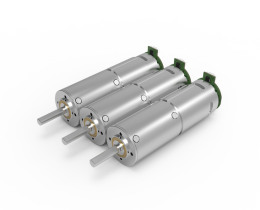


Looking for a suitable motor?


小编
Published2025-10-15
Understanding the Basics of Servo Motors
In the realm of automation, robotics, and precise machinery, servo motors have established themselves as indispensable components. Whether you're building a robotic arm, designing a drone, or setting up an automated sensor system, knowing how a servo motor works is fundamental to achieving accurate control and reliable performance.

A servo motor is a rotary actuator that allows precise control of angular position, speed, and acceleration. Unlike a standard motor that just spins continuously when power is supplied, a servo motor is embedded within a control system that enables precise positioning. Think of it as a highly intelligent motor that knows exactly where it is, where it needs to go, and how fast to get there.
This precision is achieved through its internal feedback mechanism combined with its control circuitry. Most commonly, servo motors are used in closed-loop systems, meaning they constantly check their position and make adjustments to stay on target. This feature makes them ideal for applications requiring high accuracy, such as robotics, CNC machinery, camera gimbals, and even remote-controlled vehicles.
Key Components of a Servo Motor
To understand how a servo motor operates, it's helpful to look at its main parts:
Motor (DC or Brushless): The core component that provides the rotational force or torque.
Gear Train: Reduces the motor's high speed to a suitable speed while increasing torque. Gears also help in achieving fine position control.
Position Encoder or Potentiometer: A feedback device that reports the current position of the motor shaft back to the control circuit.
Control Circuit: The brain that interprets signals, compares the desired position with the feedback, and adjusts the motor's activity accordingly.
Power Supply: Provides the necessary energy for the motor to operate.
How a Servo Motor Works: The Control Loop
The magic of a servo motor lies in its closed-loop control system, often called a "servo loop". Here's an outline of how this process functions:
Receiving the Command Signal: The servo motor gets a control signal—most commonly a Pulse Width Modulation (PWM) signal—representing the desired position or speed.
Interpreting the Signal: The control circuit compares this command to the feedback from the position sensor, which reports where the shaft currently is.
Adjusting Power: Based on the difference (also known as error), the control circuit adjusts the voltage and current delivered to the motor to correct the position.
Achieving and Maintaining Position: As the motor moves, the feedback sensor updates the control system about its current position. The system iteratively makes small adjustments until the target position is reached and maintained.
This real-time feedback mechanism ensures that the servo motor responds swiftly and accurately, even if external forces or loads change unexpectedly.
Different Types of Servo Motors
While the term "servo motor" broadly refers to motors used in control systems, there are two primary types:
AC Servos: Operate on alternating current and typically feature brushless designs for higher efficiency and longevity. They are often used in industrial automation.
DC Servos: Run on direct current and are common in hobbyist projects and smaller applications. They are simpler to control with basic electronics.
Another classification is based on their motor type:
Brush DC Servo Motors: Easy to control, but require maintenance due to brush wear.
Brushless DC (BLDC) Servo Motors: More durable and efficient, with higher speed and torque capabilities.
Understanding these differences can help you decide the right type of servo motor for your project or application.
Basic Working Principles in Practice
Imagine you're controlling a robotic arm's joint with a servo motor. You send a PWM signal that indicates "turn to 45 degrees". The servo's control circuitry interprets this command and energizes the motor until the position sensor reports the shaft has reached that angle. If an external force pushes against it or if the command changes, the system quickly reacts, adjusting power to keep the joint at the correct position.
This process might sound complex, but in practice, it all happens within milliseconds, providing seamless and precise motion control. The more sophisticated the servo motor's feedback system, the higher its accuracy and responsiveness.
Applications of Servo Motors
Their ability to provide precise position control makes servo motors ideal for a wide array of applications:
Robotics: For joint movement and manipulator control.
Aerospace & Defense: For stabilizers and antenna positioning.
CNC Machines: To ensure tools follow accurate paths.
Camera Gimbals: For smooth stabilization and tracking.
Automated Manufacturing: For conveyor systems and assembly lines.
Model Vehicles & Drones: For steering, elevators, and camera stabilization.
Getting Started with a Basic Setup
When you are just starting, a typical servo motor setup involves connecting it to your control board—like an Arduino—using a PWM signal pin, power, and ground. Additionally, you connect the feedback sensor internally or externally, depending on the model.
While that sounds straightforward, choosing the right power supply, understanding torque ratings, and ensuring your control signals match the servo's specifications are important considerations. Proper calibration and testing can make a huge difference in achieving desired performance levels.
In upcoming sections, we’ll explore how to connect a servo motor, program it to respond to commands, and troubleshoot common issues. Whether you want to automate a project or design complex machinery, understanding these foundational principles will foster confidence in working with servo motors.
Harnessing Servo Motor Control: From Wiring to Fine-Tuning
Now that we’ve explored what a servo motor is and its internal workings, it’s time to dive into practical application. Getting a servo motor to perform well in your projects requires understanding wiring, programming, control signals, and calibration. Let's walk through each step to ensure you're equipped to make the most of this powerful component.
Wiring and Power Supply Considerations
Proper wiring is the first step toward effective servo control:
Power: Most hobbyist servos operate at 4.8V to 6V. Using a stable power source that can supply sufficient current—especially under load—is crucial. For multiple servos or high-torque units, a dedicated power supply is recommended to prevent voltage drops.
Signal Line: Usually a thin wire (often yellow or white) that carries the PWM control signal.
Ground: Connect the ground of the power supply, control board (like Arduino), and servo together to ensure a common reference point.
Always avoid sharing power lines with high-current devices to prevent interference and signal noise. Using decoupling capacitors near the servo power lines can also improve stability.
Programming and Sending Commands
Using microcontrollers like Arduino, Raspberry Pi, or similar platforms, you can send PWM signals to control servo positions:
Libraries: Platforms typically have dedicated libraries—like Arduino's Servo library—making it straightforward to set angles.
Angles or Raw PWM: Commands can be in degrees (0-180°) or raw PWM signals. Check your servo's specifications.
Basic example with Arduino:
#include Servo myServo; void setup() { myServo.attach(9); // PWM pin 9 } void loop() { myServo.write(90); // Move to 90 degrees delay(1000); // Wait for 1 second myServo.write(0); // Move to 0 degrees delay(1000); }
Calibration and Fine-Tuning
Servos sometimes do not reach the exact angle intended due to mechanical slack, load, or manufacturing tolerances. Fine-tuning involves:
Adjusting endpoints: Some servos support setting min/max pulse widths to calibrate the range.
Centering calibration: Ensuring the servo's "mid" position matches 90°.
Controlling Load: Excessive load can prevent the servo from reaching its target. Use appropriate gear ratios and ensure the servo's torque ratings are sufficient.
Programming Limits: Offset commands slightly to prevent mechanical collisions or over-travel.
Advanced Feedback Control
In industrial or robotics applications, you might want to implement custom feedback algorithms:
Sensors: Using encoders or potentiometers to monitor position more precisely.
Closed-loop control: Developing PID controllers that adjust PWM signals based on sensor feedback to improve accuracy and response time.
Communication Protocols: Using protocols like CAN bus or EtherCAT for high-speed, reliable servo control in complex systems.
Troubleshooting Common Issues
Working with servo motors can sometimes lead to frustrations. Here are a few common issues and solutions:
Servo jitter or buzzing: Often caused by inadequate power or interference. Ensure power supply is stable and noise-free.
Inability to reach target position: Overload or mechanical binding. Check for obstructions or excessive torque demand.
Servo running beyond limits: Lost calibration. Recalibrate endpoints and limits.
Overheating: Continuous operation at high loads can heat the motor. Use heat sinks, reduce load, or select a higher-rated servo.
Safety Tips and Best Practices
Always use a power supply capable of delivering sufficient current for all connected servos.
Avoid forcing the servo beyond its mechanical limits; potential damage can occur.
Secure all mechanical components firmly to prevent accidents during operation.
When designing robotic arms or moving parts, consider incorporating physical stops to prevent over-travel.
Regularly check wiring connections and insulation to prevent shorts or disconnections.
Integrating Servo Motors into Complex Systems
Once comfortable with basic control, you can integrate servo motors into more sophisticated systems:
Multi-Servo Systems: Coordinating multiple servos for robot limbs or camera rigs.
Sensor Feedback: Combining with IR, ultrasonic, or vision sensors for autonomous control.
Remote Operation: Wireless control via Bluetooth, WiFi, or RF modules.
Automation and Programming: Using microcontrollers or PLCs for predefined movement sequences or real-time adjustments.
Getting a servo motor to work effectively is a blend of understanding its internal working principles, proper wiring, programming, calibration, and troubleshooting. By mastering these elements, you'll be able to design precise, reliable, and responsive systems—whether for hobby projects or professional applications.
The versatility of servo motors opens up limitless possibilities. From tiny robotic arms to large industrial machinery, these components form the backbone of modern automation and control. Experiment, refine, and explore—the world of servo motors is both fascinating and rewarding.
And remember: the key to great control isn't just understanding how they work—it's knowing how to make them work for you.
Leveraging innovations in modular drive technology, Kpower integrates high-performance motors, precision reducers, and multi-protocol control systems to provide efficient and customized smart drive system solutions.
Update:2025-10-15
Contact Kpower's product specialist to recommend suitable motor or gearbox for your product.